By Faith Peddycord & Dr. Thomas Orr
As you prepare to start an exercise routine, you pick a specific song that seems to give you energy. As a youth hockey team steps on the ice to the shrills of AC/DC’s Thunderstruck they feel the energy and possibly become more alert and focused on their game. Young people bouncing off the wall to music created well before they were born in timeless examples of stadium rock that appear to be timeless. A worn out professional athlete listens to classical music in order to find peace and solitude before going to bed. The combination of music and sport is common, yet not often thought about. There have been numerous studies done that demonstrate the importance of listening to music while exercising or performing a sport. The effects of music are endless and are helpful for people with all experiences with sport. In this paper, there is going to be an approach to the positive effects that listening to music has when listened both before and during exercise.
Jock Jams Album Cover
When thinking about how music can influence sport activities, it is important to think about how it relates to our feelings and interactions. In The Impact of Music on Sports Activities: A Scoping Review by Majid Akhshabi and Mohammad Rahimi, they look at how exactly music does this. They believe that there are four mechanisms used, “reducing the feeling of tiredness, increasing excitement levels, creating harmony, and finally increasing calmness and the sense of comfort” (Akhshabi, M., & Rahimi, M., 2021). If an athlete feels exhausted, playing music with more energy can transfer to them, allowing them to feel more energized and play better. Similarly, if music with more energy is played, there can be increased excitement both on the playing field, on the court, or on the ice, and in the stands. As far as creating harmony, music can help form a bond between people, especially when listening to the same music. Music can fairly easily bring out emotions in people, and the emotions will typically be similar between people. With this, if music is played during practice or a game, harmony can be formed bringing fans and players closer together. Finally, with increasing comfort and calmness, music can be used as a relaxation technique. If someone has performance anxiety, it might be beneficial to play soothing music for them prior to a game. This can allow the sympathetic nervous system to become less aroused and they can focus on what matters most. By looking at these four mechanisms, coaches can better prepare teams for games and build that relationship between fans and players.
Taking a more in-depth look at energy, professional athletes have their own experiences with how music can affect the energy on the field. A professional baseball player described an experience he has had in the article Sound Affects: How Music Transforms the Way We Consume Sport by Khalid Ballouli. He describes an experience of when the first batter walks to the plate with the song If You’re Gonna Play in Texas (You Gotta Have a Fiddle in the Band) by Alabama, in which there was a high amount of energy (Ballouli, K., 2017). This energy translated into the stands where fans were on their feet and singing along with the song. However, when the next batter walked out to Neighborhood Superstar by the Hot Boys, fans stopped singing and the energy diminished. This observation is presumed to be affected by the amount of energy in the music as the second batter was a good player. During the first song, the music was upbeat, and fans were easily able to sing along with it, however, during the second song, the music had been slowed as if to represent being played on a record. By slowing the music down, there seemed to be less energy present, thus, influencing fans to calm down. This describes how easily music can form that bond between players and fans. When music is upbeat, it can feel as if there is more support coming from the fans while when music is slower and more rap like, if can end up not feeling as supportive.
Music not only can affect people’s emotions, but also their movement. In the article Music and Sport: Exploring the Intersections by Jonathan Long and Karl Spracklen, they compare music and sports with how similar these concepts can be. They mention that Erwin Strauss believes that music influences people’s movements like dancing and marching (Long, J., & Spracklen, K., 2020). This would mean that it is likely that our movements when playing a sport can be influenced by music in the background. Even thinking back to how music affects emotion and energy, if there is energetic music in the background, athletes are going to be more likely to move with more energy. The authors also mention how Strauss describes how sound influences movement more than vision. While visualization can be useful in some cases, it might be better to use music as a way to perform movements. These two methods, however, can be linked together by playing music in the background when using visualization. Sound being more linked to movement than vision is said to be due to “the same experiential perceptual space”. This being said, music can help encourage athletes to move in certain ways during practices and while performing.
Beyond what is mentioned above, music is also useful in other contexts other than sports. In the article The Sound of Success: Investigating Cognitive and Behavioral Effects of Motivational Music in Sports by Elvers and Steffens, the authors mention how music is helpful in improving the coordination of those with Parkinson’s Disease (Elvers, P., & Steffens, J., 2017). When listening to music during rehabilitation interventions, patients were able to have greater accuracy with movements and overall improved motor coordination. However, the study also showed this in a healthy control which can be related over to athletes as well. The authors of this article also mention how common it is for music to be used as pre-performance enhancement in sports involving balls. This most likely has something to do with the idea that music improves motor coordination. Overall, this has been difficult to prove exactly how music improves motor coordination, but there is some evidence around strong neural connections between the motor and auditory cortexes. With this, music is going to be helpful in preparing athletes for performances in games and competitions as well as practice.
There isn’t just one article that mentions the importance of music on motor coordination. In the article Relationship Between Music and Sport Performance: Toward a Complex and Dynamical Perspective by H. Chtourou et al, listening to music presents more positive effects than negative. These positive effects include improving motor coordination and motivation (Chtourou, H, et al., 2015). According to researchers, one potential reason for these positive effects might have something to do with the therapeutic nature of music. They also mention how widespread the use of music is among recreational activities as well as in motor rehabilitation programs. With music having a wide range of abilities, there is no surprise when it comes to believing how important music is in exercise and sport. Among these positive effects, there is also improvement seen in athletes’ agility and psychomotor capabilities. Balance and agility is extremely important in various sports, therefore, if music has the capability to help improve the agility of athletes, it is useful. By using music during practices and performances, games, and competitions, coaches are going to better be able to encourage the highest performance possible done by their athletes.
Going back to the idea of emotions, music played while exercising can improve people’s happiness. In the article Music Enhances Performance and Perceived Enjoyment of Sprint Interval Exercise by Matthew J. Stork, Matthew Y. W. Kwan, Martin J. Gibala, and Kathleen A. Martin Ginis, researchers looked at how someone’s perceived feeling changed from the presence of music. Sure enough, people who had listened to their choosing of a playlist reported a higher feelings score throughout the entire exercise session (Stork, M. J., et al., 2014). When considering motivation, those who listened to music also reported a higher task motivation score for the entirety of the session than those not listening to music. Similarly, the overall perceived enjoyment among participants was consistently higher than those who listened to music. This was in support of the original hypothesis. The overall end statistics from this study was that 95% of participants said that exercise was more enjoyable with music, and 100% of participants said they would do sprint interval training again while listening to music. From this study, it becomes clearer that music can help encourage exercise and make the experience more enjoyable.
When thinking about music more specifically, it does matter what music is chosen. In the textbook Foundations of Sport and Exercise Psychology by Robert Weinberg and Daniel Gould, it has been suggested that athletes will choose their music prior to competition to fit various moods. Athletes will consciously make this selection by thinking about what they want their mood to be like and what kind of arousal level they would like as well (Weinber, R., & Gould, D., 2024). Typically, it is common for athletes to want a higher arousal, therefore, they might choose music to arouse them. In this textbook, researchers also discuss what music can do to an athlete’s perception. For example, the perception of effort can be lowered, thus reducing the perception of exertion. By allowing music to be played and reducing the perceived effort, athletes might have an easier time working out and doing their best because the activity can seem more fun while they are still giving their best. In studies mentioned in the textbook, music did not seem to depend on the intensity of the exercise. Instead, there seemed to be an enhanced effect regardless of the intensity.
After thinking about all the positive effects music can have when involved with exercise, it is important to understand if it matters when the music is played. In the article Music and Exercise: What Current Research Tells Us by Jeanette Bicknell, reflection on the dependency of music is discussed. She used the example of going to a cycling class and if there was no music, she would most likely pack up her things and go home (Bicknell, J., 2013). The use of music during exercise helps to make the environment more fun and for some people, take their mind off what they are doing. Again, she also touches on the importance of having music prior to exercise and during exercise with all the positive effects they come with. When music is played prior to exercise, it has been shown to “increase arousal, facilitate relevant imagery, and improve the performance of simple tasks”. Increased arousal is seen again to be a positive effect, but Bicknell also touches more specifically on the improved performance with simple tasks and imagery. Like discussed earlier, pairing music and imagery can improve an athlete’s performance as more neural connections will be made to better visualize the expected outcome. Bicknell also mentions the positive effects during exercise when music is played. This includes “delay fatigue and lessen the subjective perception of fatigue”. When people are listening to music, they can end up in a happier mood, thus allowing them to focus on the music and less on the perceived effort they are doing. From this article, the positive effects of music during exercise are emphasized more, demonstrating its importance in sport and exercise.
Furthermore, there are many articles that mention the positive effects of listening to music before and during exercise. To continue this idea, the article Effects of Music in Exercise and Sport: A Meta-Analytic Review by Peter Terry, Costas Karageorghis, Michelle Curran, Olwenn Matin, and Renee Parsons-Smith discuss another positive effect. They say that listening to music also improves physiological efficiency (Terry, P. C., 2020). When thinking about how music can increase efficiency, this can be applied to everyday activities like cleaning. Since music can increase enjoyment, this might explain how efficiency also improves. Going back to exercise though, if efficiency is higher, they can either learn more skills and get better at older ones faster or do more efficient strength training that can be beneficial in the long run. The authors also discuss the aspects of music that connect people together. Events that involve music include weddings, funerals, and initiation ceremonies. They also explain that “it rouses soldiers preparing to enter the fray and serves to coordinate their onward march”. Similarly to how it can help line soldiers up, coaches can use music to help connect athletes on the same team to better predict where a teammate might throw a ball for example. Therefore, music can be an essential communication method for teams while also being enjoyable.
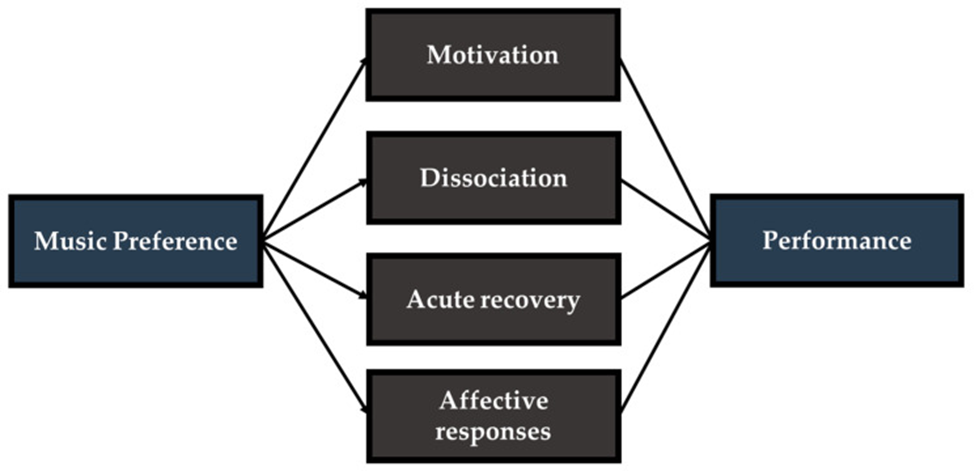
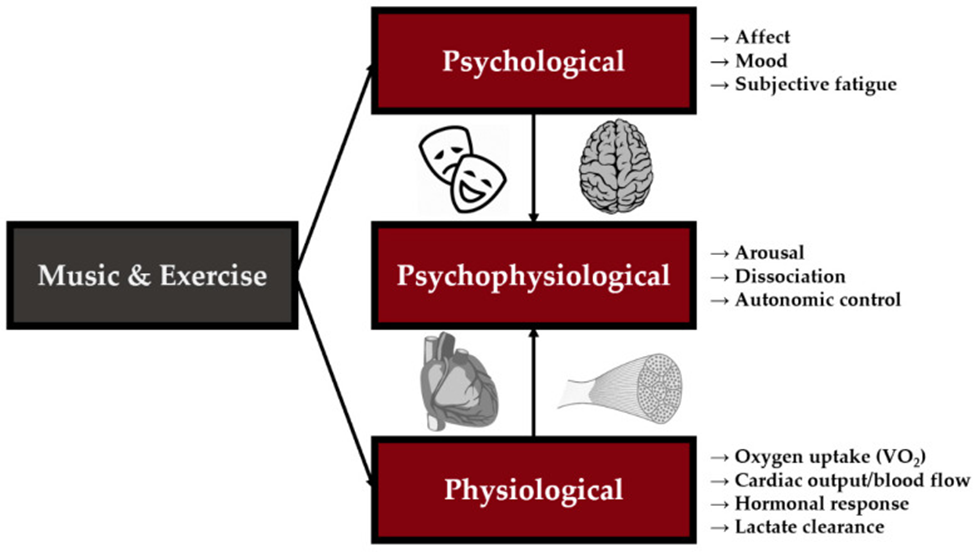
Music, however, has been used since the 20th century during sporting events. In the article The Influence of Music Preference on Exercise Responses and Performance: A Review by Christopher Ballmann, it is discussed about how music showed up in the Olympics as early as the 20th century. Music would be played in between ceremonies and was even used during events like figure skating and gymnastics (Ballmann, C. G., 2021). Now, it is common to find music at most sporting events. This article also discusses the physiological importance of listening to music. One of those factors is the neural connections in the brain which increase awareness of emotion, perception, and arousal. This is the biological basis for why athletes and people who exercise perceive exercise as less difficult or demanding, have higher arousal levels, and are happy and enjoy exercising. There has also been research found around listening to music while cycling. When listening to music while cycling, there is a “prevention of a decreased heart rate variability (HRV) following exercise indicating the preservation of parasympathetic stimulation following physical stress”. This is better for the heart and physical health because the parasympathetic nervous system and sympathetic nervous system will have an easier time adapting to stress. Overall, while exercise is good for a person’s health, listening to music while exercising is even better.
There are several factors to consider when debating whether listening to music is the right thing while exercising. The most important thing is to think about all the positive effects that music can have on a person’s mental and physical health. When thinking about their mental health, music can improve mood, increase arousal, and perceive less effort. This can make athletes happier and more efficient during their exercise as well. As far as physical health goes, when listening to music during exercise, there is a prevention of decreased heart rate variability resulting in better communication between the parasympathetic and sympathetic nervous system. From all of this information, it can be concluded that there are several positive effects that listening to music before and during exercise has to make it worth playing music for athletes before and during practices and games or performances. When you need a lift, “pumping up the jam” may be just the right idea.
References
Akhshabi, M., & Rahimi, M. (2021). The impact of music on sports activities: A scoping review. Journal of New Studies in Sport Management.
Ballmann, C. G. (2021). The influence of music preference on exercise responses and performance. Journal of Functional Morphology and Kinesiology, 33.
Ballouli, K. (2017). Sound affects: How music transforms the way we consume sport. Journal of the Sport Entertainment & Venues Tomorrow Conference, 3-8.
Bicknell, J. (2013, January 30). Music and exercise: What current research tells us. Retrieved from Psychology Today: https://www.psychologytoday.com/us/blog/why-musci-moves-us/201301/music-and-exercise-what-current-research-tells-us?msockid=1d8be38981ab61c5379af788800660a0
Chtourou, H., Briki, W., Aloui, A., Driss, T., Souissi, N., & Chaouachi, A. (2015). Relationship between music and sport performance: Toward a complex and dynamical perspective. Science & Sports.
Elvers, P. & Steffens, J. (2017). The sound of success: Investigating cognitive and behavioral effects of motivational music in sports. Front Psychology, 8.
Long, J., & Spracklen, K. (2020). Music and sport: Exploring the intersections. Sport in Society, 1-7.
Stork, M. J., Kwan, M. Y., Gibala, M. J., & Martin Ginis, K. A. (2015). Music enhances performance and perceived enjoyment of sprint interval exercise. Journal of the American College of Sports Medicine, 1052-1060.
Terry, P. C., Karageorghis, C. I., Martin, O. V., & Parsons-Smith, R. L. (2020). Effects of music in exercise and sport: A meta-analytic review. Psychological Bulletin, 91-117.
Weinberg, R. S., & Gould, D. (2024). Foundations of sport and exercise psychology. Champaign, Il: Human Kinetics.