A Guide to Leading an Appropriate Prayer after a Sporting Event
By Dr. Thomas Orr, Professor at the University of Mary
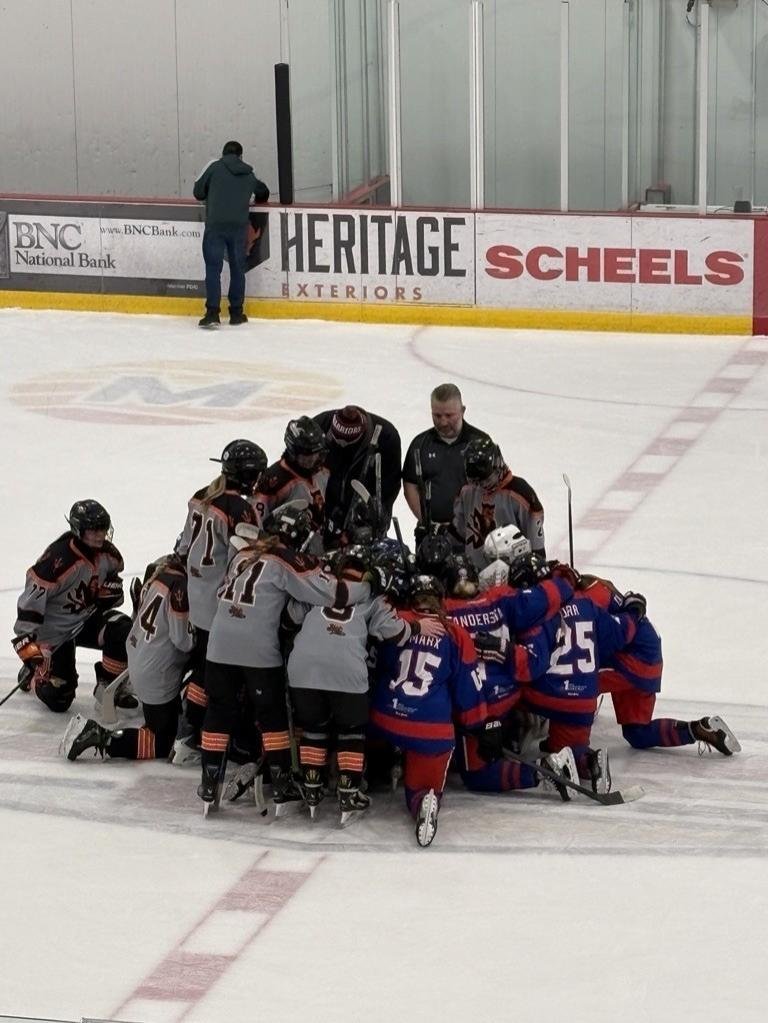
(Picture of Dr. Orr leading prayer, photo credit to Brian Larson)
“Leading others in prayer need not be complicated or intimidating. A simple, sincere prayer offered with faith and reverence is entirely fitting.” (UMary Protocol For Leading Public Prayer, 2026)
After an emotional and difficult loss to end a great season of ACHA D1 hockey for the University of Mary at the hands of a very good Liberty University team, several of our coaches and players accepted the invitation of their players and we created a prayer circle. As an assistant coach I joined my goaltender Kyle Hayden whose career had just ended with him giving everything he had left in the tank and I knew was deeply religious and had wanted to pray after games and approached the gathering group that included several of our other players who had also been invited or made the conscious decision to join. We embraced the victorious Liberty players and for a few brief moments paused in a reflection of sportsmanship and virtue. A Catholic University and an Evangelical Christion University joined together in sport and prayer for what was a great game down to the wire that concluded not in a brawl, but in humility and brotherhood.
There has been a surprising amount of debate around the growth of sport teams and public prayer. In the state of Minnesota, youth hockey associations were considering banning or limiting prayer circles after games for many alleged reasons, but primarily for the stress it could put on their tight schedules for their facility. District ten, who did ban prayer and decided to enforce it by punishing any team who prays coach by giving him or her a game misconduct and game suspension. This effectively made players stop the prayer circle, and instantly the social media campaign and wider support for those players became strong. (https://www.facebook.com/groups/1261150780637587/posts/24454145197578151/) After review both Minnesota Hockey and District 10 worked together to allow prayer again, with modifications being considered that would help with scheduling.
Opposing viewpoints included the idea of forcing God onto the public. The consideration of religious freedom and public displays of fidelity to a particular version of “our” God is of course both political and controversial as well with many people opposing any direct influence of society by a public group displaying actions that show a connection to religion. A public high school team may have reasons to avoid showing a formal and coordinated prayer that may favor one brand of religion, while a private Catholic University like the University of Mary may take pride in this display of benevolence and virtue.
The introductory story of the Liberty prayer circle had been captured by media. Both video and pictures spread and our University President, Monsignor James Shea, a renowned Catholic Leader had seen the images. While at his residence for a gathering he told me how happy he was to see myself and our team praying after the game. As soon as I accepted the compliment the second part of his point had arrived, “Tom, why don’t we do this at our games?”. At that point I had my charge and quickly consulted our University Chaplain, Fr. Jared Wolf for advice and courage. We planned on starting the prayer circle immediately the next season at the first game against Iowa State. We also added a bible study group for the first time in our programs history. Having been a part of Dr. Rich Holdeman’s bible study group for my hockey team at Indiana University I was happy to help create a group and received some extra help from our new assistant coach, Jared Spooner who has a rich background in faith and athletics. Additionally we had a solid group of new players who wanted to both participate in a bible study and post game prayer circle who provided the passion and desire for these acts of community religion.
We conducted the first prayer circle against Iowa State, and continued the practice throughout the season. It has remained a part of the culture of the hockey team and is done after every single game now. The leaders on the team continue to deliver a message and blessing that should be welcomed by opposing players and teammates alike. As stated in our guide for public prayer, “And when you lead prayer, you are not simply praying while everyone else listens. You are giving voice to the prayer of the whole gathering. Those present join their hearts to the words you offer on their behalf.”
The Men I worked with at the college level were often nervous and not sure what they should say. When I coached my younger daughters team, I realized that most of these 14 year olds were both intimidated and unprepared to lead a public prayer. I would let them lead and let them get the experience I think is important, but would also be saying my own prayer in my head that they did not “put their foot in their mouth” or that they would simply have the courage to speak. It was some of the giggles and sometimes strange moments I have had as a part of prayer circle that has led to the question of, “What should I say?”
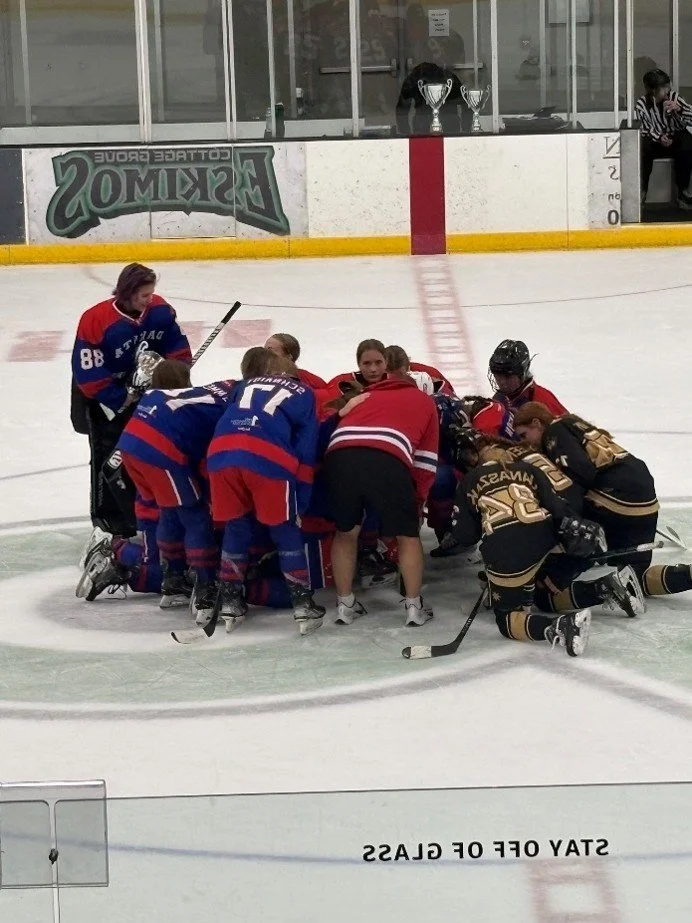
(Dr. Orr praying with 14U Lamoureux Dakota Warriors in Minnesota; Photo Credit Misty Strilcov)
“Above all, remember what you have been asked to do: for a brief moment, turn the attention of those gathered toward God and give voice to their gratitude, their needs, and their trust in Him.” (UMary Protocol For Leading Public Prayer, 2026)
1) Smile and be kind to each other (treat each other like you just played Christ).
2) The home team should have a plan for who will lead the prayer but if not quickly sort this out and let someone lead.
3) Find confidence and speak loudly because its noisy in a sport facility. With respect for the facility schedule it is good to have a plan in mind so that we rush but do not hurry and hurry but do not rush as John Wooden would say.
4) Express gratitude to God for the opportunity to engage with each other in sport.
5) Pray for the travel of the teams safety and comfort.
6) Including something where reflections of growth or character can be a nice touch.
7) If a player was seriously injured it might be appropriate to pray for their health. If no one was injured, you could pray in thanks for everyone’s health and safety.
8) If there are any known causes such as a recent death or sickness in the community it might be good to include this in your prayer
9) Repentance for a play or something that just happened could be a good topic however judgment must be made on if it helps the situation or not?
10) Conclude with love and servitude to others as what happens on the ice stays on the ice (or field, turf, court, diamond, pool, etc).
When it is appropriate for a public prayer circle, the above mentioned tips can be very helpful to share with student athletes so that we are able to honor God while being respectful of our teammates, opponents, fans and the facility which includes the next teams who need to use the venue.
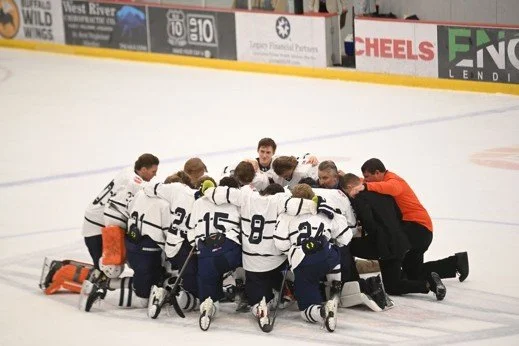
(Picture of ISU Prayer with Fr. Jarad Wolf, Coach Jared Spooner, Will Falconer, Lyndon Orr, etc ; photo credit to Brian Larson)
For further reading and viewing;
University of Mary Protocol For Leading Public Prayer
Minnesota situation;
https://www.cbsnews.com/minnesota/news/hockey-postgame-prayer-penalty/